Data & AI Systems That Automate Operations and Deliver Reliable Outputs
I design and build production-ready AI systems that replace manual workflows, structure messy data, and deliver accurate outputs you can rely on - integrated into your existing tools.
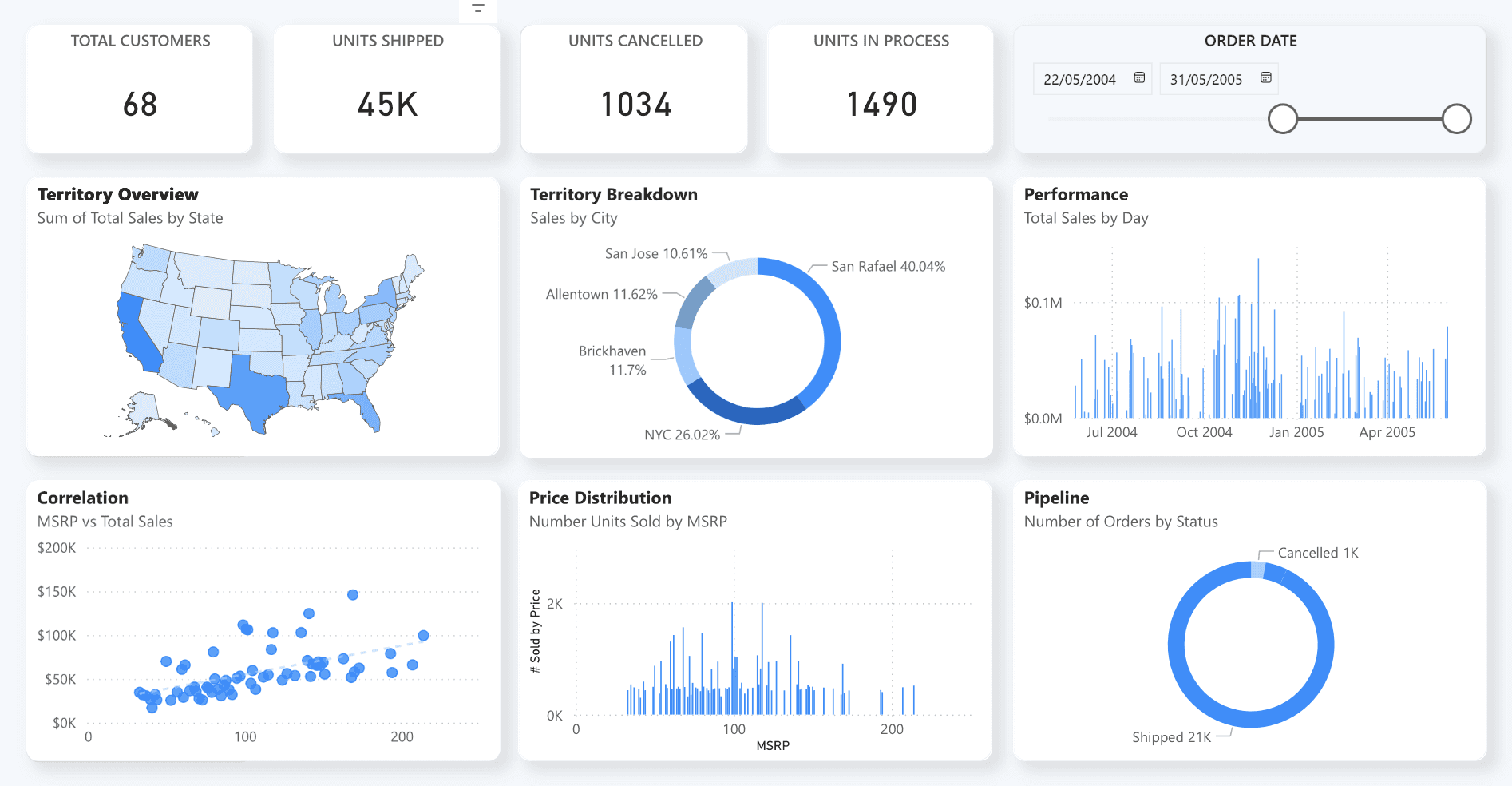
I help teams eliminate manual processes, automate workflows, and implement practical AI solutions that integrate
with existing systems.
Works with the tools your team already uses.
Build stack:
Integrates with:
AI Automation & Reporting Systems for Growing Teams
Deploy AI-powered workflows, product features, and executive dashboards that reduce manual work, improve accuracy, and deliver measurable operational ROI, in 1–2 weeks.
OPERATIONS AUTOMATION
Intelligent Operations Automation Sprint
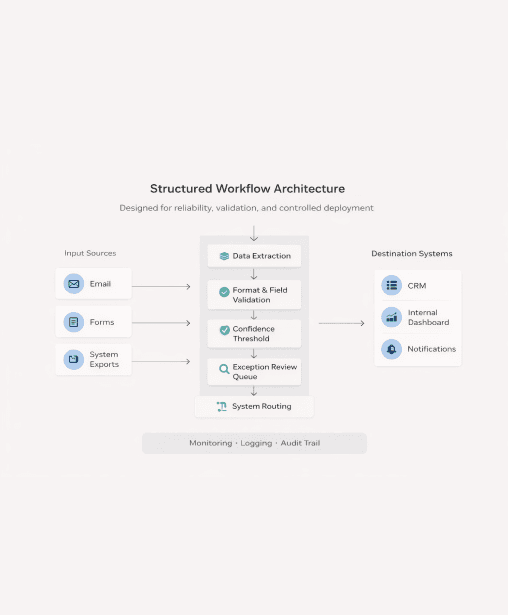
Automate one high-friction operational workflow end-to-end, with AI extraction, validation rules, human review, and full audit logging. Delivered in 5–8 days.
What You Receive:
✓ End-to-end workflow automation
✓ AI extraction with schema validation
✓ Human review queue for low-confidence cases
✓ Integrations (Gmail, Slack, HubSpot, Sheets, etc.)
✓ Monitoring + audit trail
✓ Runbook + team training
Typical Outcomes:
Up to 60% reduction in manual handling time
<5% post-review correction rate
Zero silent failures
Full traceability for compliance
OPERATIONS AUTOMATION
Intelligent Operations Automation Sprint
Automate one high-friction operational workflow end-to-end, with AI extraction, validation rules, human review, and full audit logging. Delivered in 5–8 days.
What You Receive:
✓ End-to-end workflow automation
✓ AI extraction with schema validation
✓ Human review queue for low-confidence cases
✓ Integrations (Gmail, Slack, HubSpot, Sheets, etc.)
✓ Monitoring + audit trail
✓ Runbook + team training
Typical Outcomes:
Up to 60% reduction in manual handling time
<5% post-review correction rate
Zero silent failures
Full traceability for compliance
PRODUCT AI INTEGRATION
AI Integration Sprint (Production-Ready Feature in 1 Week)
Add one production AI feature to your product — with structured outputs, validation rules, fallback logic, cost controls, and security baseline.
Engineered for real-world deployment and built for production environments, with structured outputs, safeguards, and seamless backend integration.
Best for:
• B2B SaaS teams adding AI features
• Technical founders without in-house ML expertise
• Internal tools teams augmenting workflows
• Product teams needing structured AI outputs
What You Receive:
✓ Production AI features (scoped upfront)
✓ Structured JSON outputs + schema validation
✓ Human fallback paths for low confidence
✓ Evaluation pack (20–50 test cases)
✓ Security baseline (PII handling, injection defences)
✓ Deployment to staging + handover
Typical Impact:
85–95% structured output accuracy
>95% schema compliance
Controlled AI cost exposure
Safe deployment with fallback logic
PRODUCT AI INTEGRATION
AI Integration Sprint (Production-Ready Feature in 1 Week)
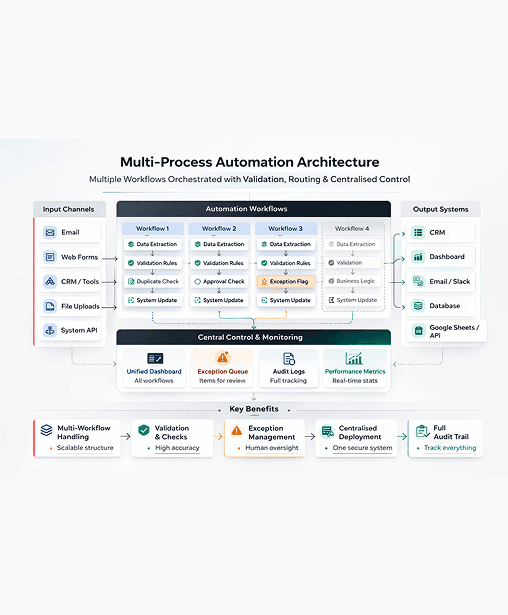
Add one production AI feature to your product — with structured outputs, validation rules, fallback logic, cost controls, and security baseline.
Engineered for real-world deployment and built for production environments, with structured outputs, safeguards, and seamless backend integration.
Best for:
• B2B SaaS teams adding AI features
• Technical founders without in-house ML expertise
• Internal tools teams augmenting workflows
• Product teams needing structured AI outputs
What You Receive:
✓ Production AI features (scoped upfront)
✓ Structured JSON outputs + schema validation
✓ Human fallback paths for low confidence
✓ Evaluation pack (20–50 test cases)
✓ Security baseline (PII handling, injection defences)
✓ Deployment to staging + handover
Typical Impact:
85–95% structured output accuracy
>95% schema compliance
Controlled AI cost exposure
Safe deployment with fallback logic
Specialised AI, Data & Backend Systems
Production AI Systems Designed for Measurable Operational Impact
Fixed-scope systems built to remove manual work, improve accuracy, and deliver consistent outputs, designed for real business use.
DATA & REPORTING SYSTEMS
Inbound Lead Processing & Routing System
Automatically capture, structure, and route inbound leads from forms, emails, or CRM inputs. Replace manual triage with a reliable system that extracts key data, applies validation rules, and routes leads to the correct team with full traceability.
Key Details:
End-to-end lead processing workflow
Structured data extraction (AI-powered)
Validation rules + confidence scoring
Automatic routing (CRM, Slack, email)
Monitoring, logging, and audit trail
Reduces manual handling time, improves response speed, and ensures consistent lead qualification without operational bottlenecks.
KNOWLEDGE SYSTEMS
Executive KPI Dashboard & Reporting Automation
Replace manual spreadsheet reporting with a structured data pipeline and executive dashboard. Your metrics are defined once, reconciled automatically, and updated on a reliable schedule, giving leadership accurate, decision-ready insights.
Key Details:
Multi-source data integration
Clean transformation pipeline (validated metrics)
Executive dashboard (Power BI or equivalent)
Drill-down views for operational insight
Automated refresh and delivery
Eliminates reporting overhead, improves data confidence, and enables faster, more informed decision-making.
BACKEND ENGINEERING
Internal AI Knowledge Assistant (RAG System)
Deploy an internal AI assistant that answers questions using your company’s documents, with clear citations. Designed for accuracy and control, not generic chatbot responses, enabling teams to access reliable information instantly.
Key Details:
Document ingestion and indexing
Retrieval-augmented generation (RAG)
Citation-backed responses
Guardrails and content controls
Admin interface and update workflow
Reduces time spent searching for information, improves consistency of answers, and enables scalable internal knowledge access.
Specialised AI, Data & Backend Systems
Production AI Systems Designed for Measurable Operational Impact
Fixed-scope systems built to remove manual work, improve accuracy, and deliver consistent outputs, designed for real business use.
DATA & REPORTING SYSTEMS
Inbound Lead Processing & Routing System
Automatically capture, structure, and route inbound leads from forms, emails, or CRM inputs. Replace manual triage with a reliable system that extracts key data, applies validation rules, and routes leads to the correct team with full traceability.
Key Details:
End-to-end lead processing workflow
Structured data extraction (AI-powered)
Validation rules + confidence scoring
Automatic routing (CRM, Slack, email)
Monitoring, logging, and audit trail
Reduces manual handling time, improves response speed, and ensures consistent lead qualification without operational bottlenecks.
KNOWLEDGE SYSTEMS
Executive KPI Dashboard & Reporting Automation
Replace manual spreadsheet reporting with a structured data pipeline and executive dashboard. Your metrics are defined once, reconciled automatically, and updated on a reliable schedule, giving leadership accurate, decision-ready insights.
Key Details:
Multi-source data integration
Clean transformation pipeline (validated metrics)
Executive dashboard (Power BI or equivalent)
Drill-down views for operational insight
Automated refresh and delivery
Eliminates reporting overhead, improves data confidence, and enables faster, more informed decision-making.
BACKEND ENGINEERING
Internal AI Knowledge Assistant (RAG System)
Deploy an internal AI assistant that answers questions using your company’s documents, with clear citations. Designed for accuracy and control, not generic chatbot responses, enabling teams to access reliable information instantly.
Key Details:
Document ingestion and indexing
Retrieval-augmented generation (RAG)
Citation-backed responses
Guardrails and content controls
Admin interface and update workflow
Reduces time spent searching for information, improves consistency of answers, and enables scalable internal knowledge access.
Production Systems & Technical Case Studies
Selected production builds and representative implementations demonstrating AI integration, data engineering, and automation systems delivered in structured sprints.

AUTOMATION SYSTEMS
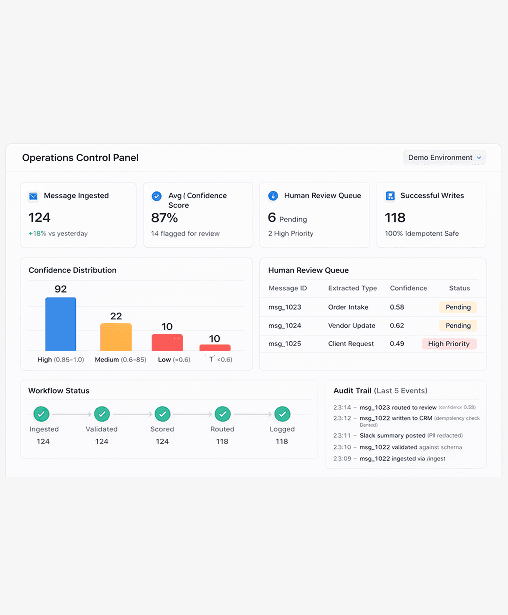
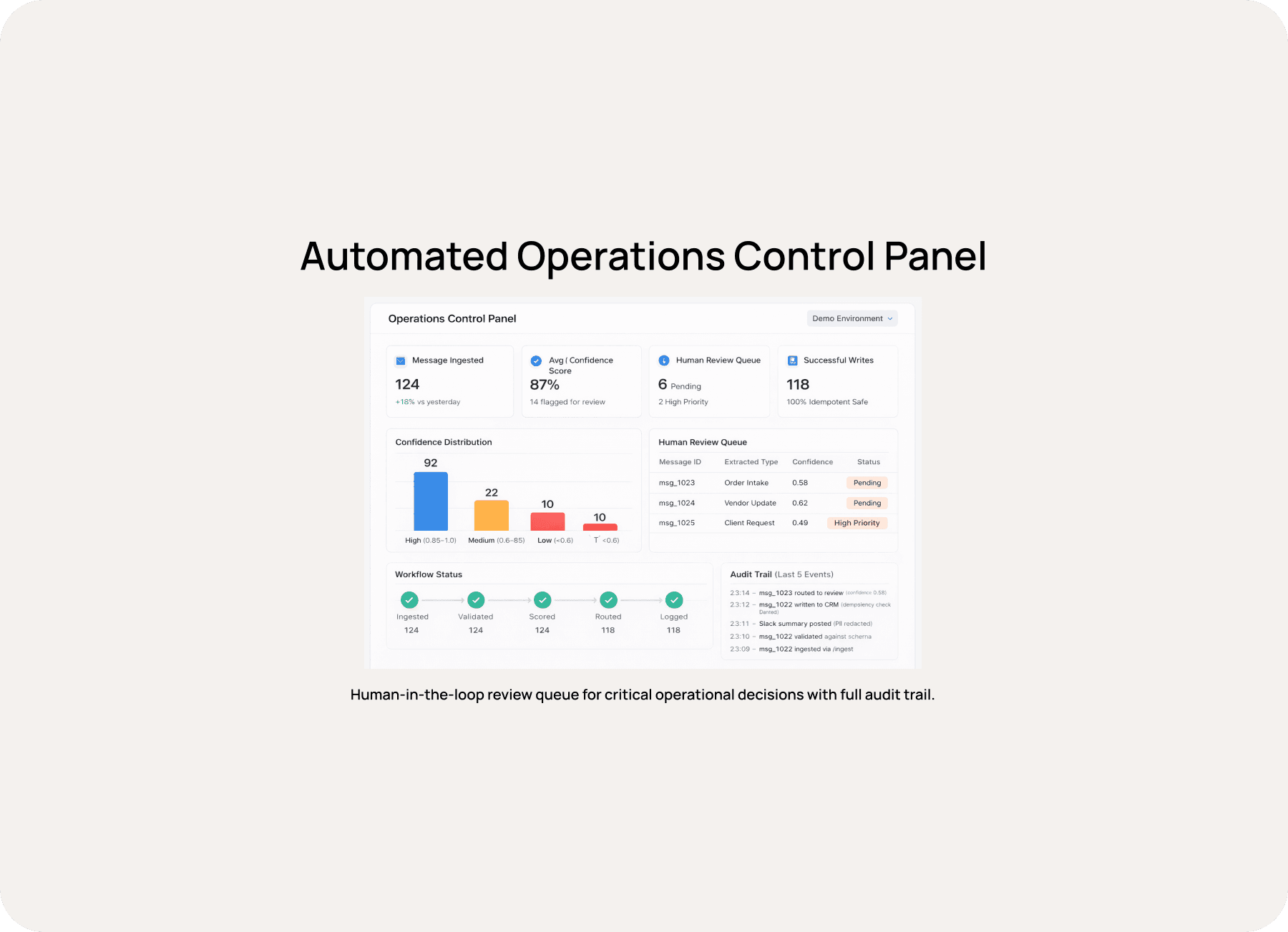
Guardrailed Workflow Automation with Human Oversight
Client Challenge: Operations team processing 200+ high-value requests weekly via manual email review, inconsistent data quality, no audit trail, team capacity maxed out.
System Scope:
Webhook-triggered ingestion with structured extraction (JSON schema validation)
Confidence scoring with automatic human review routing for <85% certainty
Idempotency protection for safe retries
PII redaction in all external notifications
Full audit trail of every decision and system action
Operational Impact:
60% reduction in manual processing time
<5% error rate on structured outputs
Clear escalation workflow for edge cases
Production-ready guardrails prevent silent failures
Tech Stack:
Python • FastAPI • Claude API • Pydantic • PostgreSQL • Slack
AUTOMATION SYSTEMS
Guardrailed Workflow Automation with Human Oversight
Client Challenge: Operations team processing 200+ high-value requests weekly via manual email review, inconsistent data quality, no audit trail, team capacity maxed out.
System Scope:
Webhook-triggered ingestion with structured extraction (JSON schema validation)
Confidence scoring with automatic human review routing for <85% certainty
Idempotency protection for safe retries
PII redaction in all external notifications
Full audit trail of every decision and system action
Operational Impact:
60% reduction in manual processing time
<5% error rate on structured outputs
Clear escalation workflow for edge cases
Production-ready guardrails prevent silent failures
Tech Stack:
Python • FastAPI • Claude API • Pydantic • PostgreSQL • Slack
AUTOMATION SYSTEMS
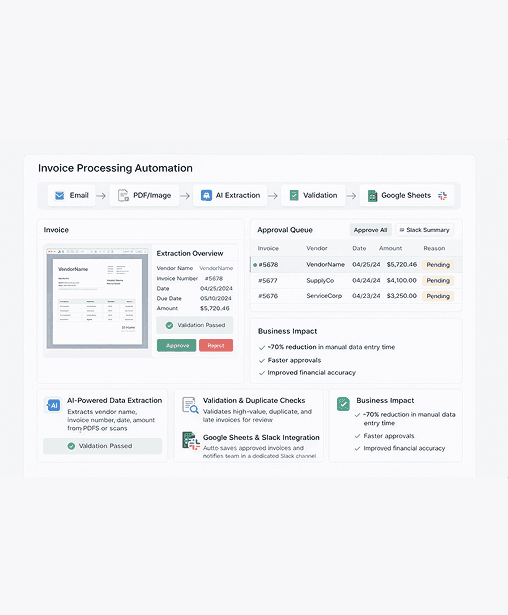
Invoice Processing with Approval Workflow
Client Challenge: Finance team spending 8+ hours weekly on manual invoice data entry from PDFs and images — delays in approvals, poor visibility into processing status.
System Scope:
PDF/image ingestion with AI-powered extraction to structured JSON
Duplicate detection and validation checks (vendor, amount, PO matching)
Automatic approval routing for invoices >£500
Google Sheets integration for finance team visibility
Slack notifications at each approval stage
Operational Impact:
70% reduction in manual data entry time
Faster approval cycles
Improved financial accuracy with validation rules
Full traceability of invoice processing history
Tech Stack:
Python • FastAPI • Claude API • Google Sheets API • Slack
AUTOMATION SYSTEMS
Invoice Processing with Approval Workflow
Client Challenge: Finance team spending 8+ hours weekly on manual invoice data entry from PDFs and images — delays in approvals, poor visibility into processing status.
System Scope:
PDF/image ingestion with AI-powered extraction to structured JSON
Duplicate detection and validation checks (vendor, amount, PO matching)
Automatic approval routing for invoices >£500
Google Sheets integration for finance team visibility
Slack notifications at each approval stage
Operational Impact:
70% reduction in manual data entry time
Faster approval cycles
Improved financial accuracy with validation rules
Full traceability of invoice processing history
Tech Stack:
Python • FastAPI • Claude API • Google Sheets API • Slack
REPORTING SYSTEMS
Multi-Source KPI Automation & Executive Dashboard
Client Challenge: Operations team spending 8 hours weekly on manual reporting — spreadsheet consolidation from multiple sources, inconsistent KPI definitions, low confidence in numbers.
Client Challenge: Operations team spending 8 hours weekly on manual reporting, spreadsheet consolidation from multiple sources, inconsistent KPI definitions, low confidence in numbers.
System Scope:
Multi-source ingestion (Stripe, HubSpot, Google Sheets, SQL databases)
Python ETL pipeline with data quality checks (nulls, duplicates, schema validation)
Metric logic table as single source of truth for KPI definitions
Power BI executive dashboard: 1 overview + 2 drill-downs
Automated refresh runbook for independent operation
Operational Impact:
90% reduction in reporting time (8 hours → 45 minutes)
KPI reconciliation to agreed definitions
Refreshable dataset with validation checks
Team operates dashboard independently after handover
Tech Stack:
Python • SQL • Power BI • Pandas • SQLite/PostgreSQL
AI INTEGRATION SYSTEMS
Support Ticket Classification & Routing
Client Challenge: Support team manually triaging 50–200 tickets daily, slow first response times, inconsistent routing, no prioritization logic.
System Scope:
Multi-class ticket classification (bug, feature request, billing, technical)
Urgency and sentiment detection
Automatic team routing with confidence scores
Manager-ready ticket summaries
Persistent logging with full ticket history
Operational Impact:
65% faster first response time
Consistent routing logic across all ticket types
Reduced support team workload on triage
SLA tracking visibility
Tech Stack:
Python • FastAPI • Claude API • SQLite → PostgreSQL • Slack
AI INTEGRATION SYSTEMS
Sales Meeting Notes → CRM Auto-Update
Client Challenge: Sales reps spending 2–3 hours weekly updating CRM after calls, inconsistent data quality, missing deal context, poor pipeline visibility.
System Scope:
AI extraction from meeting transcripts/notes to structured CRM fields
Mapping to HubSpot/Salesforce schema
Rep review interface (approve/edit extracted fields)
Automatic CRM write for approved updates
Audit trail of all changes
Operational Impact:
80% reduction in manual CRM updates
Better pipeline data quality
Reps focus on selling, not data entry
Complete change history for deal reviews
Tech Stack:
Python • FastAPI • Claude API • Mock HubSpot API
REPORTING SYSTEMS
Multi-Source KPI Automation & Executive Dashboard
Client Challenge: Operations team spending 8 hours weekly on manual reporting, spreadsheet consolidation from multiple sources, inconsistent KPI definitions, low confidence in numbers.
System Scope:
Multi-source ingestion (Stripe, HubSpot, Google Sheets, SQL databases)
Python ETL pipeline with data quality checks (nulls, duplicates, schema validation)
Metric logic table as single source of truth for KPI definitions
Power BI executive dashboard: 1 overview + 2 drill-downs
Automated refresh runbook for independent operation
Operational Impact:
90% reduction in reporting time (8 hours → 45 minutes)
KPI reconciliation to agreed definitions
Refreshable dataset with validation checks
Team operates dashboard independently after handover
Tech Stack:
Python • SQL • Power BI • Pandas • SQLite/PostgreSQL
AI INTEGRATION SYSTEMS
Support Ticket Classification & Routing
Client Challenge: Support team manually triaging 50–200 tickets daily, slow first response times, inconsistent routing, no prioritization logic.
System Scope:
Multi-class ticket classification (bug, feature request, billing, technical)
Urgency and sentiment detection
Automatic team routing with confidence scores
Manager-ready ticket summaries
Persistent logging with full ticket history
Operational Impact:
65% faster first response time
Consistent routing logic across all ticket types
Reduced support team workload on triage
SLA tracking visibility
Tech Stack:
Python • FastAPI • Claude API • SQLite → PostgreSQL • Slack
AI INTEGRATION SYSTEMS
Sales Meeting Notes → CRM Auto-Update
Client Challenge: Sales reps spending 2–3 hours weekly updating CRM after calls, inconsistent data quality, missing deal context, poor pipeline visibility.
System Scope:
AI extraction from meeting transcripts/notes to structured CRM fields
Mapping to HubSpot/Salesforce schema
Rep review interface (approve/edit extracted fields)
Automatic CRM write for approved updates
Audit trail of all changes
Operational Impact:
80% reduction in manual CRM updates
Better pipeline data quality
Reps focus on selling, not data entry
Complete change history for deal reviews
Tech Stack:
Python • FastAPI • Claude API • Mock HubSpot API
BESPOKE SERVICES
Custom Engineering Solutions
Need something beyond the standard sprints? I offer bespoke development for unique technical challenges
BESPOKE SERVICES
Custom Engineering Solutions
Need something beyond the standard sprints? I offer bespoke development for unique technical challenges
process
Simple 4-Step Process
Step 1
Discovery Call (15–30 minutes)
Discuss challenge, confirm scope, fixed-price proposal within 24hrs
Step 2
Project Kickoff (Day 1)
Define requirements, acceptance criteria, access setup
Step 3
Build & Iteration (Days 2–8)
Regular check-ins, working prototypes, feedback integration
Step 4
Handover & Training
Complete docs, code, training, operational runbook
Step 1
Discovery Call (15–30 minutes)
We discuss your pain point, review examples, and confirm scope. If we're aligned, you receive a fixed-price proposal with clear deliverables and timeline.
Step 3
Build & Iteration (Days 2–8)
Rapid development with regular check-ins. You review working prototypes and provide feedback. Changes within scope are included; anything beyond triggers a change control discussion.
Step 2
Project Kickoff (Day 1)
Access setup, requirement confirmation, and stakeholder alignment. We document definitions, workflows, and acceptance criteria before any build work begins.
Step 4
Handover & Training
Complete documentation, Loom walkthrough, and live training session. You receive all code, credentials, runbooks, and ongoing operational guidance.
process
Simple 4-Step Process
Step 1
Discovery Call (15–30 minutes)
Discuss challenge, confirm scope, fixed-price proposal within 24hrs
Step 2
Project Kickoff (Day 1)
Define requirements, acceptance criteria, access setup
Step 3
Build & Iteration (Days 2–8)
Regular check-ins, working prototypes, feedback integration
Step 4
Handover & Training
Complete docs, code, training, operational runbook
Step 1
Discovery Call (15–30 minutes)
We discuss your pain point, review examples, and confirm scope. If we're aligned, you receive a fixed-price proposal with clear deliverables and timeline.
Step 3
Build & Iteration (Days 2–8)
Rapid development with regular check-ins. You review working prototypes and provide feedback. Changes within scope are included; anything beyond triggers a change control discussion.
Step 2
Project Kickoff (Day 1)
Access setup, requirement confirmation, and stakeholder alignment. We document definitions, workflows, and acceptance criteria before any build work begins.
Step 4
Handover & Training
Complete documentation, Loom walkthrough, and live training session. You receive all code, credentials, runbooks, and ongoing operational guidance.
WHY WORK WITH ME
Engineering Excellence Meets Practical Business Delivery
You’re not buying a prototype, you’re buying a system that runs. I ship with clear scope, validation, and handover so your team can operate it confidently.
Technical Depth
Chemical Engineering (IChemE-accredited) + MSc Computer Science (ML/AI). Strong systems thinking: definitions, constraints, edge cases, and operational reality.
Fixed-Scope Delivery
Clear deliverables, day-by-day milestones, and acceptance criteria. No ambiguity, no drifting scope, just shipped outcomes.
Complete Handover
Runbooks, Loom walkthroughs, and a training call. Your team can refresh dashboards, monitor workflows, and extend logic without chasing you.
WHY WORK WITH ME
Engineering Excellence Meets Practical Business Delivery
You’re not buying a prototype, you’re buying a system that runs. I ship with clear scope, validation, and handover so your team can operate it confidently.
Technical Depth
Chemical Engineering (IChemE-accredited) + MSc Computer Science (ML/AI). Strong systems thinking: definitions, constraints, edge cases, and operational reality.
Fixed-Scope Delivery
Clear deliverables, day-by-day milestones, and acceptance criteria. No ambiguity, no drifting scope, just shipped outcomes.
Complete Handover
Runbooks, Loom walkthroughs, and a training call. Your team can refresh dashboards, monitor workflows, and extend logic without chasing you.
WHY WORK WITH ME
Built for Production Use
Production-Ready Systems
These systems are designed for real operational environments, with structured outputs, validation logic, fallback handling, and monitoring built in from the outset. The focus is not experimentation, but delivering reliable systems that integrate cleanly into your existing workflows and can be used with confidence.
WHY WORK WITH ME
Built for Production Use
Production-Ready Systems
These systems are designed for real operational environments, with structured outputs, validation logic, fallback handling, and monitoring built in from the outset. The focus is not experimentation, but delivering reliable systems that integrate cleanly into your existing workflows and can be used with confidence.

